Who built AI?
See who made each step of artificial intelligence, and what the world did next.
The history of AI is usually told as a list of breakthroughs. This knowledge graph puts seventy years of it on one timeline, from Alan Turing's 1950 paper to October 2026, and connects every milestone to the people and labs who made it, the work it built on, and what followed: warnings, lawsuits, laws, funding rounds and share-price moves.
Seventy years on one timeline
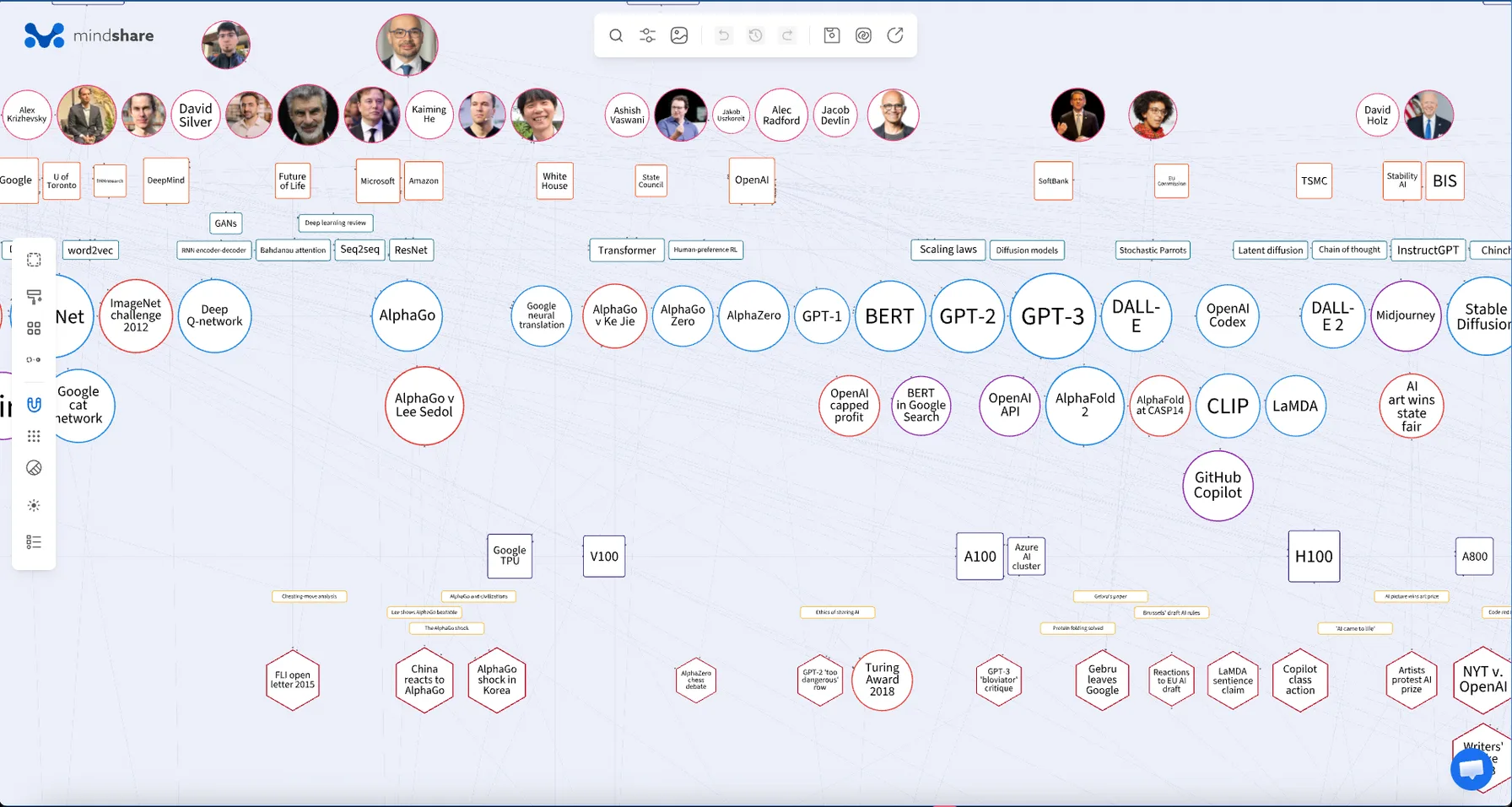
Every milestone sits where its date puts it, from left to right, under the era it belongs to: from the foundations and two AI winters to the deep learning revolution, the generative AI boom and the race for reasoning and compute. The eras since 2012 take most of the room, because most of the history happened there.
The milestones run through the middle: papers above them, chips below. The people and organisations who made them sit at the top, at the date they first appear. Everything the world did in return sits underneath, in its own rows: the news coverage, the reactions, the laws and, at the bottom, the money. The bigger the shape, the bigger the impact or the amount.
Four questions this knowledge graph answers
What did the 2012 breakthrough stand on?
In 2012 a neural network called AlexNet, built by Alex Krizhevsky, Ilya Sutskever and Geoffrey Hinton at the University of Toronto, won the ImageNet image-recognition contest with an error of 15.3 percent, against 26.2 percent for the best other team. Its arrows lead back decades: to backpropagation, the training method Hinton co-published in 1986; to ImageNet, the 2009 collection of labelled images; and to the GeForce GTX 580, a graphics card made for gamers, two of which trained it.
Follow its arrows forward and the money arrives fast. In March 2013 Google bought DNNresearch, the start-up the three had founded, for a reported 44 million dollars. Hinton stayed at Google until 2023.
What did ChatGPT set off?
OpenAI released ChatGPT on 30 November 2022, and about two months later it had an estimated 100 million monthly users. In the six months that followed, the knowledge graph ties six responses to it, in four different rows. Google declared a code red on 21 December, which led to Bard. Microsoft extended its investment in OpenAI by 10 billion dollars in January. Italy's data-protection authority blocked ChatGPT at the end of March. On 2 May Chegg's shares halved after the company said ChatGPT was hurting its growth, and Hollywood's writers went on strike, with limits on AI among their demands. On 25 May Nvidia's shares rose 24 percent in a day on the demand for its chips.
The longer arrows reach further: the New York Times lawsuit against OpenAI and Microsoft, China's rules for generative AI, and the rules for general-purpose models in the EU AI Act.
Who sounded the alarm?
Many of the warnings came from the people who built the technology. A week after GPT-4, in March 2023, an open letter asked labs to pause training anything more powerful; Yoshua Bengio and Elon Musk were among its signatories. On 1 May Geoffrey Hinton left Google so that he could speak freely about the dangers. A month later he signed a one-sentence statement on the risk of extinction from AI, together with Bengio, Demis Hassabis, Sam Altman and Dario Amodei.
The arrows run on into law. The statement fed into the UK's AI safety summit at Bletchley Park in November 2023 and its declaration. The pause letter is credited with raising the urgency behind President Biden's executive order on AI of 30 October 2023, which President Trump revoked on 20 January 2025.
What did one Chinese model do to Nvidia?
In the bottom row, Nvidia's share moves are all rises at first: a jump of 24 percent in May 2023, a market value of 1 trillion dollars days later, a record one-day gain of 277 billion dollars in February 2024. Then, on 27 January 2025, it lost 593 billion dollars of market value in a single day, the largest one-day loss for any company on Wall Street, Reuters reported.
Follow the arrows back and they lead to a chain that starts with US export controls. The October 2022 rules prompted Nvidia to make the H800, a slower chip for China. The Chinese lab DeepSeek trained its V3 model on H800s, built its reasoning model R1 on V3, and released R1 with open weights on 20 January 2025. A week later its app had overtaken ChatGPT in Apple's US App Store. Nvidia recovered: by October 2025 it was the first company worth 5 trillion dollars.
How to read the knowledge graph
-
Start with the question
Click Who built AI? at the left edge. Its description tells the whole story in a few paragraphs, from Turing's question whether machines can think to October 2026. Above the timeline the eras run across the top, from Foundations to Reasoning and compute.
-
Follow a line of models
Click Transformer, the 2017 paper by eight researchers at Google. Its arrows lead to BERT and to GPT-1, and from GPT-1 one model follows the next: GPT-2, GPT-3, GPT-3.5, GPT-4, GPT-5 and, in September 2026, GPT-6 Astra.
-
Open a match
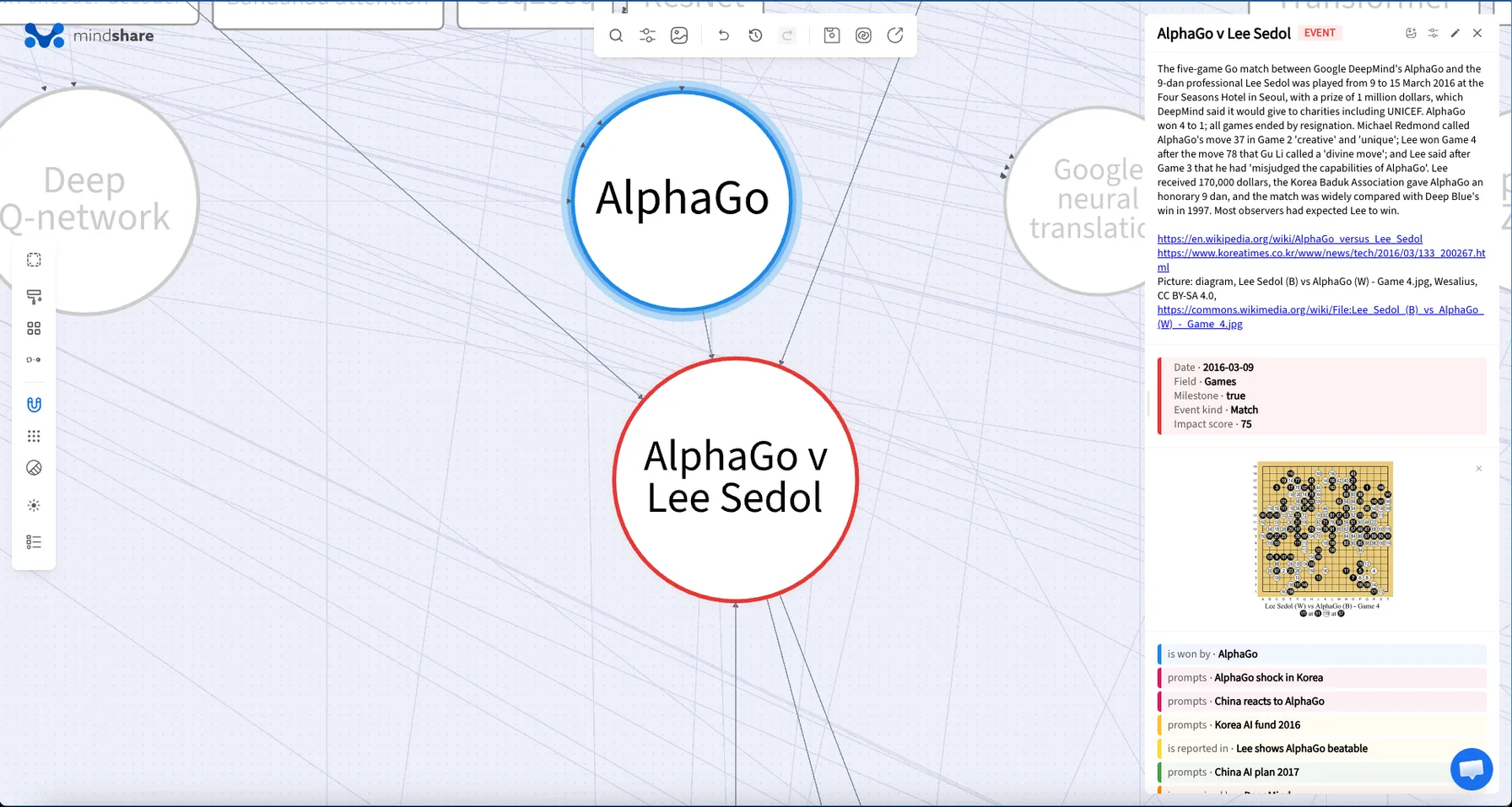
Click AlphaGo v Lee Sedol, the five games played in Seoul in March 2016. The detail panel gives the result, 4 to 1 for DeepMind's program. Around it sit the reactions: the shock in South Korea, a government fund of about 863 million dollars for AI research announced two days after the match ended, the debate in China and, a year later, China's national AI plan.
-
Follow a person
Click Geoffrey Hinton. His connections run across the whole timeline: the 1986 backpropagation paper, the students he supervised, AlexNet, the company Google bought, his years at Google and his departure, the 2018 Turing Award and the 2024 Nobel Prize in Physics.
-
Read the money
The bottom row holds the funding rounds and the share-price moves, sized by the dollars involved. Among the largest is Stargate, a 500 billion dollar plan for AI infrastructure, announced at the White House on 21 January 2025 by President Trump with Sam Altman and Masayoshi Son.
Map the history of your own field
Any field with a long story works the same way: a technology, a market, a branch of medicine. Make the kinds of things types, such as milestone, person, organisation, reaction and deal. Give every item a date, connect each milestone to who made it and what it built on, and connect every reaction to what it reacted to. See how properties and types work, or ask us for help preparing the data.