A Jira Project, Untangled
See which team is waiting on which, and why the pilot date is at risk.
A Jira board shows one sprint at a time, and a dependency hides in a link you have to open. This knowledge graph lays a whole project on one timeline: eight teams, six sprints, every issue with its parent, its blockers and its comment thread. Follow any chain of blocked work to where it ends, and see what is holding it up.
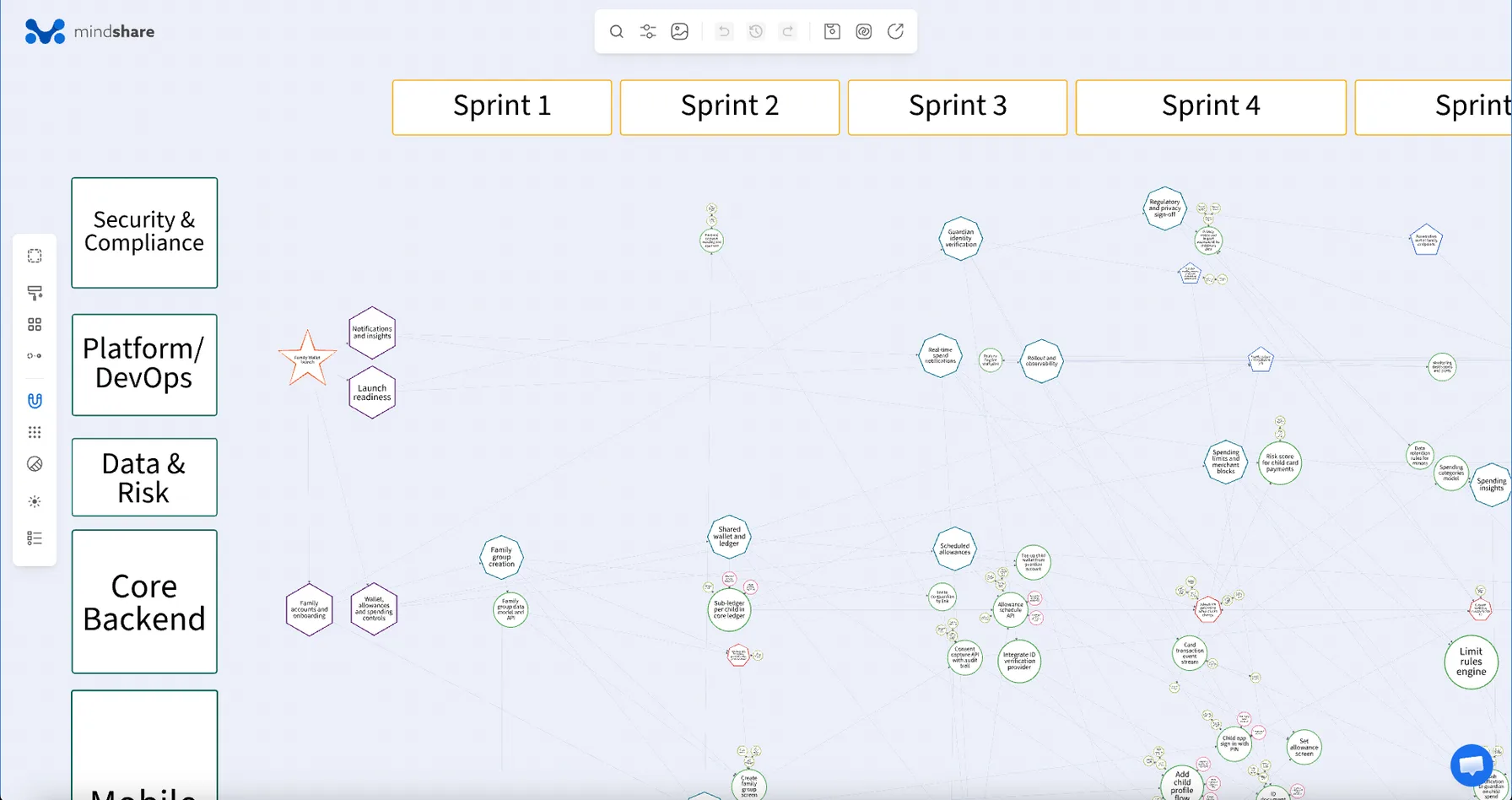
The whole project on one timeline
Every story, task and bug is a dot. Its date sets where it sits from left to right, under the bars of the sprints, and its team sets its row. The bigger the dot, the more story points it carries. Parent links tie each issue to its feature, the features to their epics and the epics to the one initiative at the top. Blocking links run between the rows, so when one team waits on another, you see the line.
The comments hang off the issues they belong to, replies off the comments they answer. A decision made in a thread sits next to the work it changed.
Four questions this knowledge graph answers
What is holding up the pilot?
The chains of blocked work end at one task: the staff pilot go/no-go on 4 November. Six items block it, and only one of them, the feature flag, is done. Still open are the regression suite, the privacy sign-off, the penetration test, the load test and, since 14 October, a reopened bug.
Every issue carries how many open blockers it has and whether another team holds them, so one filter shows all the work that is waiting: 13 issues, and for every one of them the blocker belongs to another team.
Where is the bottleneck?
Three teams' work waits on one backend story, the card transaction event stream: the risk score, the guardian's push message and the spending categories. It was carried over from Sprint 3 when the card processor's test feed was down for two days, and on 13 October the product owner raised it to Highest. Behind it sits everything in spending limits and insights.
The map shows the same shape once before. The per-child sub-ledger held up three items, the top-up, the reconciliation job and the allowance schedule, until it was done on 24 September; then the chain moved on. One bottleneck cleared, one still open, side by side.
What did nobody plan for?
The child app needs its own app ID, signing certificates and push keys. Nobody planned that work. It surfaced on 1 October as a question in a comment, who owns the push key?, and was filed the next day. It still sits in the backlog with no owner and no estimate, yet it blocks two stories planned before it: the child app's PIN sign-in in Sprint 4 and the push message in Sprint 5.
It is not the only blocker planned too late. Five issues are marked as waiting on work scheduled after them, the go/no-go among them: its load test is planned for Sprint 6, after the decision.
What happened to the bug that came back?
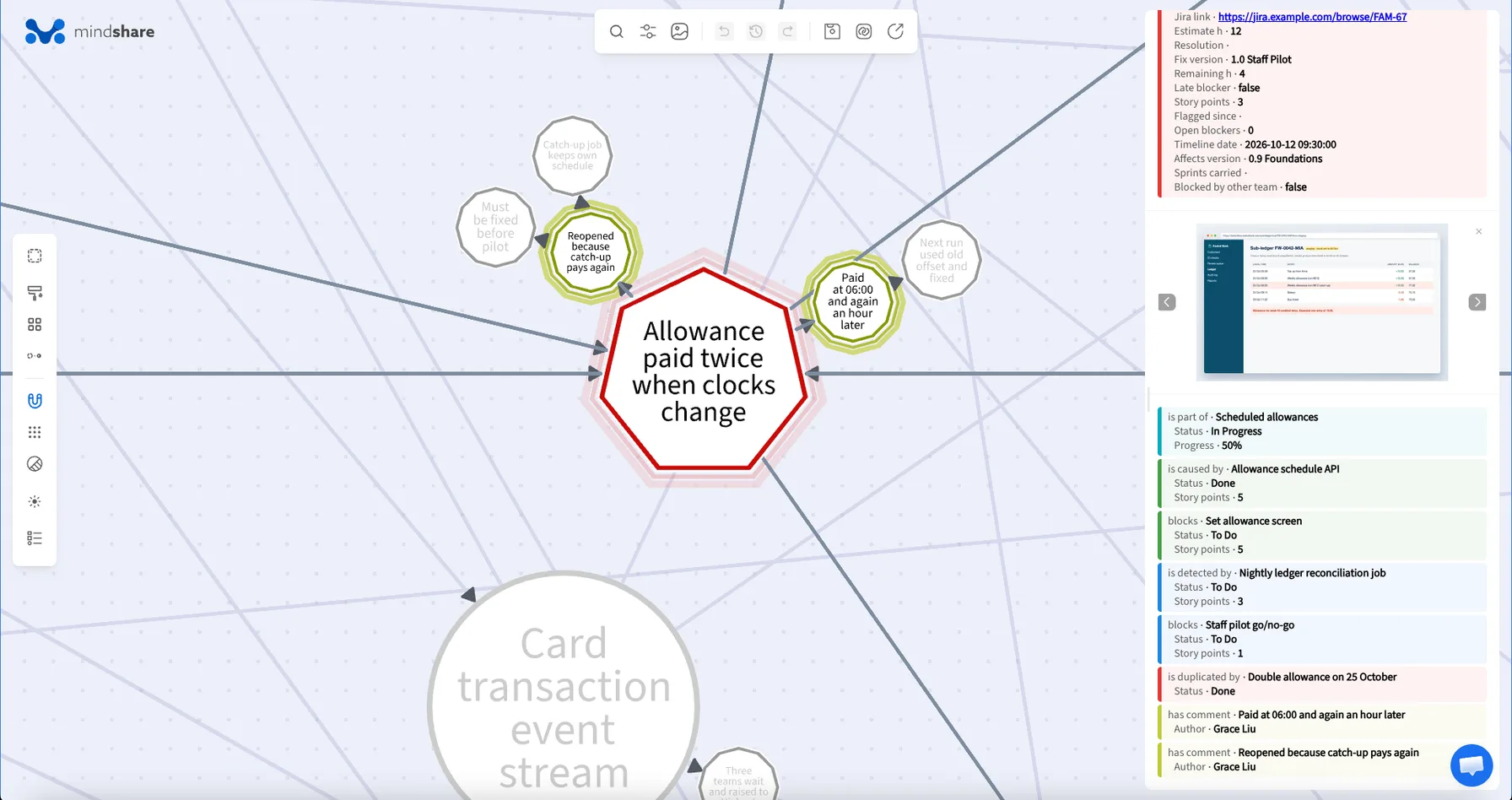
QA filed it on 9 October: when the clocks go back an hour, a child's allowance is paid at 06:00 and again an hour later. It was fixed and closed on 13 October and reopened the next morning, because the catch-up job that pays missed runs keeps its own copy of the schedule.
Its connections show how far it reaches. It was caused by the allowance schedule API, it now blocks the set-allowance screen and the pilot go/no-go, the nightly reconciliation job should catch it, and a second report on 15 October was closed as its duplicate. Its five comments tell the story in order, and it must be fixed by 23 October, before the clocks change on the 25th.
How to read the knowledge graph
-
Start with the sprints and the teams
The sprint bars run across the top, from Sprint 1 on 31 August to Sprint 6, with the backlog at the far end. The teams run down the left: Core Backend, Mobile, Web, Design/UX, Data & Risk, QA, Security & Compliance and Platform/DevOps. Click Sprint 4 to see the active sprint's goal and dates, 12 to 23 October.
-
Open the initiative
Click the star, Family Wallet launch. The detail panel shows the business fields kept above the epics: health At risk, an approved budget of €1.45 million against a forecast of €1.52 million, and the key result of 25,000 active family wallets by 30 June 2027. Its connections lead to the four epics.
-
Follow a chain that cleared
Click Create family group screen in the Mobile row. It waited on a design and an API, both done before Sprint 2. Two days in, a test guardian with a joint account could not create a group; Mobile filed a bug against Core Backend, it was fixed on 21 September and the screen was done on 24 September.
-
Read a thread
Open Allowance paid twice when clocks change and follow its comments: the report, the fix, the reopen, the developer's answer and the product owner's ruling that it must be fixed before the pilot.
-
Check a team
Click Mobile at the left. It holds 10 issues, 8 of them open and 2 flagged, with 13 of its 53 committed story points completed. Compare it with the other teams' rows to see where the open work piles up.
Map a project of your own
A Jira project already has the parts: issues, their parents, their blockers, sprints, teams and comments. Make each issue type a node type, keep the links as connections, and turn the fields you want to compare by, such as status, team, story points or flagged, into properties you can filter on. See how properties and types work, or ask us for help preparing the data.