Trial of Humanity
What eighty years of fiction say we should argue when we are judged.
Since the 1940s, science fiction has kept staging the same scene: a superior power arrives and asks whether humanity deserves to survive. This knowledge graph gathers 53 of those trials, from Fredric Brown's Arena (1944) to Star Trek: Picard (2022), together with the messages the real world has sent into space, so you can see which arguments win, who speaks for us and how the verdicts end.
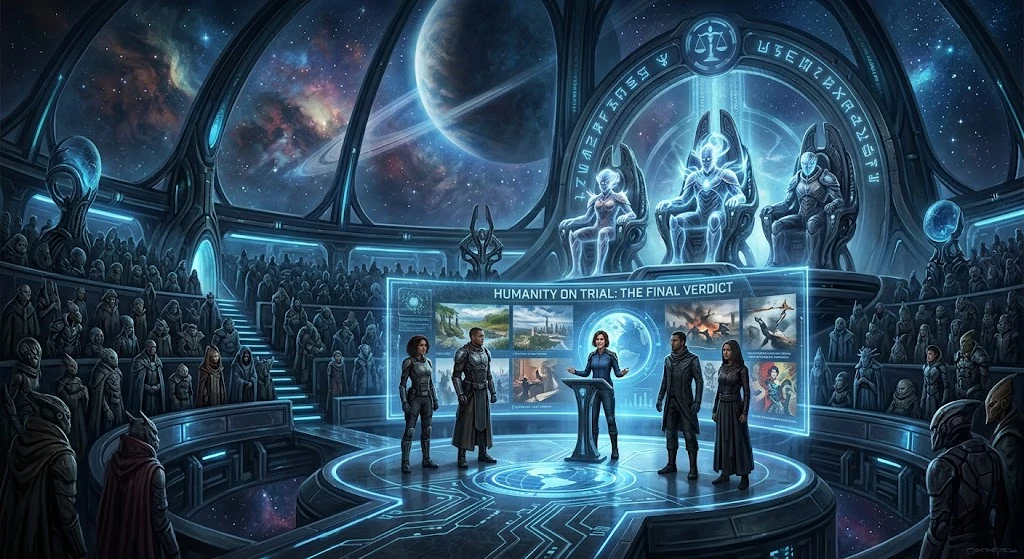
Every trial, broken into the same parts
A story about humanity on trial always has the same pieces: someone accuses, someone judges, someone speaks for us, a case is made in some form, and a verdict follows. Put each of those pieces on the map once and connect every story to them, and fifty-odd stories that seem unrelated start to line up.
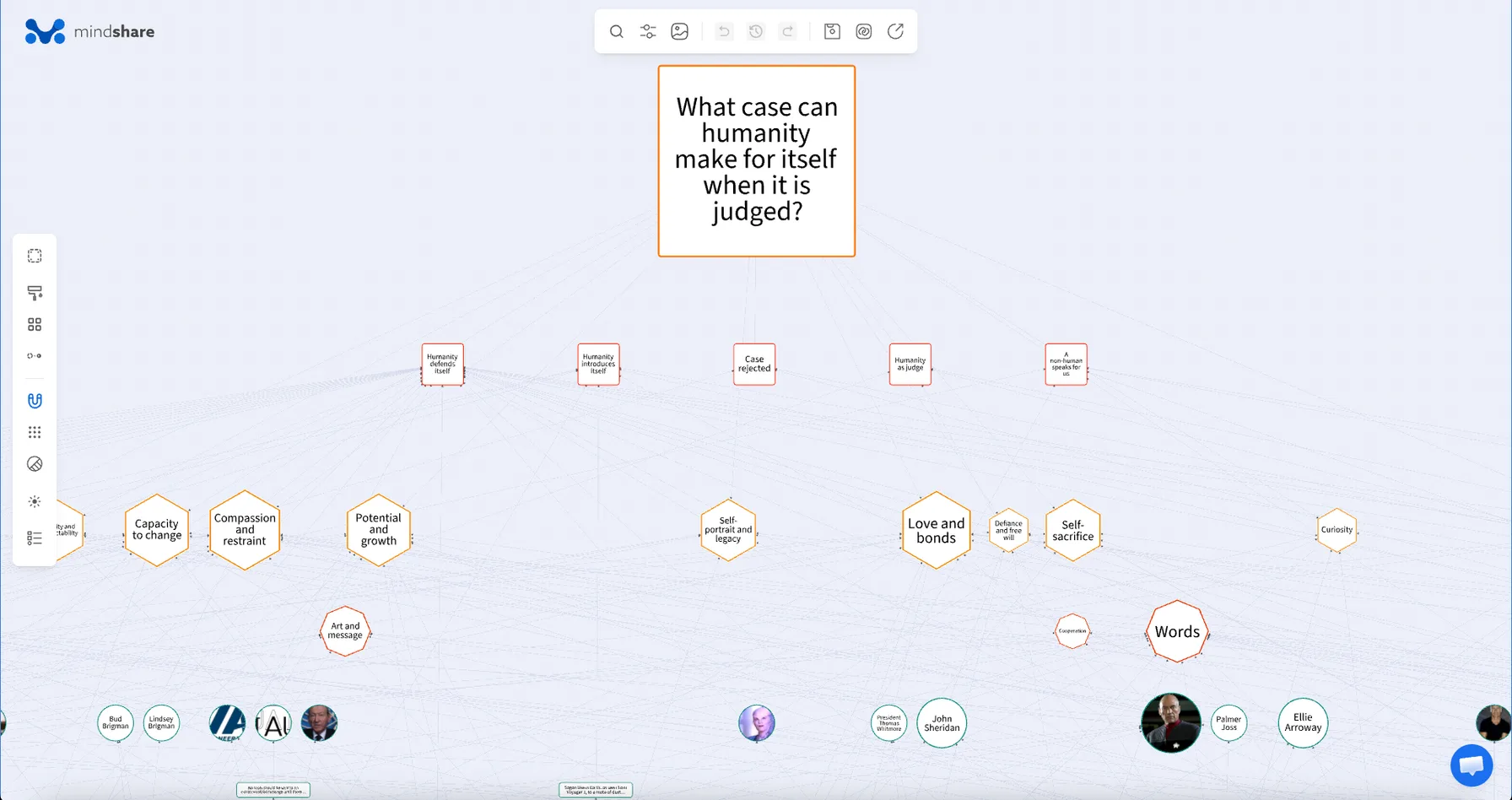
Four questions this knowledge graph answers
Which arguments actually win?
Each argument carries two numbers: how often it is made and how often humanity is spared after making it. Click an argument and the detail panel shows both; narrow the map to the arguments that have won at least five times, the way you would query a database.
The answer is not the obvious one. Compassion and restraint is the most common case, made in 13 stories, but it wins only 6. Unity across difference wins 7 of 9, love and bonds 8 of 12, and defiance and free will 4 of 5. Humanity's self-portrait, the case our real-world messages make, has been made 7 times and has never won: no one has answered yet.
Do deeds beat words?
Pick the form Deeds and follow its connections to the stories and from there to their verdicts. Then do the same for Words. Humanity is spared in 10 of the 15 stories where it proves itself through an act, such as Kirk sparing the Gorn in Arena or Bud diving to the bottom of the ocean in The Abyss, and in 7 of the 19 where it argues.
Who speaks for us?
Every advocate is marked human, non-human or a collective. Narrow the map to the non-human ones and the line-up appears: the Doctor, Spock, the Minbari Delenn, the synthetic Isaac from The Orville and the Eternals. 53 advocates are human, 15 are not, and 5 are groups, such as the International Astronomical Union.
What has the real world said, and who answered?
Eight points on the map are not fiction: the Pioneer plaque (1972), the Arecibo message (1974), the Voyager Golden Record (1977), Carl Sagan's Pale Blue Dot (1994), the Cosmic Call broadcasts (from 1999), the 1989 declaration on what to do after detecting a signal, and the debate and 2015 statement on messaging other civilisations. Here humanity speaks first. Follow any of them to its verdict and it ends in the same place: no verdict.
How to read the knowledge graph
-
Start with the question in the middle
Everything leads back to one question: what case can humanity make for itself when it is judged? Click it and the detail panel sums up what the whole map shows. Its connections are the eleven arguments humanity offers in its defence, from compassion and restraint to curiosity.
-
Pick an argument and see where it was made
Open Unity across difference. On one side it leads to the stories in which humanity answered with it: the heptapods' gift in Arrival, President Whitmore's speech in Independence Day, Thor naming humanity the Fifth Race in Stargate SG-1, Shepard refusing the Catalyst in Mass Effect 3. On the other it leads to the charges it answers, such as Danger to others, and from a charge you reach every other argument that rebuts it.
-
Open a story to see the whole trial
Click Heptapods offer a weapon (a gift) from Arrival (2016). The detail panel gives the stakes, global war from mistranslation, and humanity's flaw, humans interpret the offer as a threat. Around it sit every part of the trial: the stance (humanity defends itself), the arguments (unity and curiosity), the judge (the heptapods), the advocate (Louise Banks) with a paraphrase of what she argued, the form the case takes (cooperation), the verdict (spared) and the title the moment belongs to.
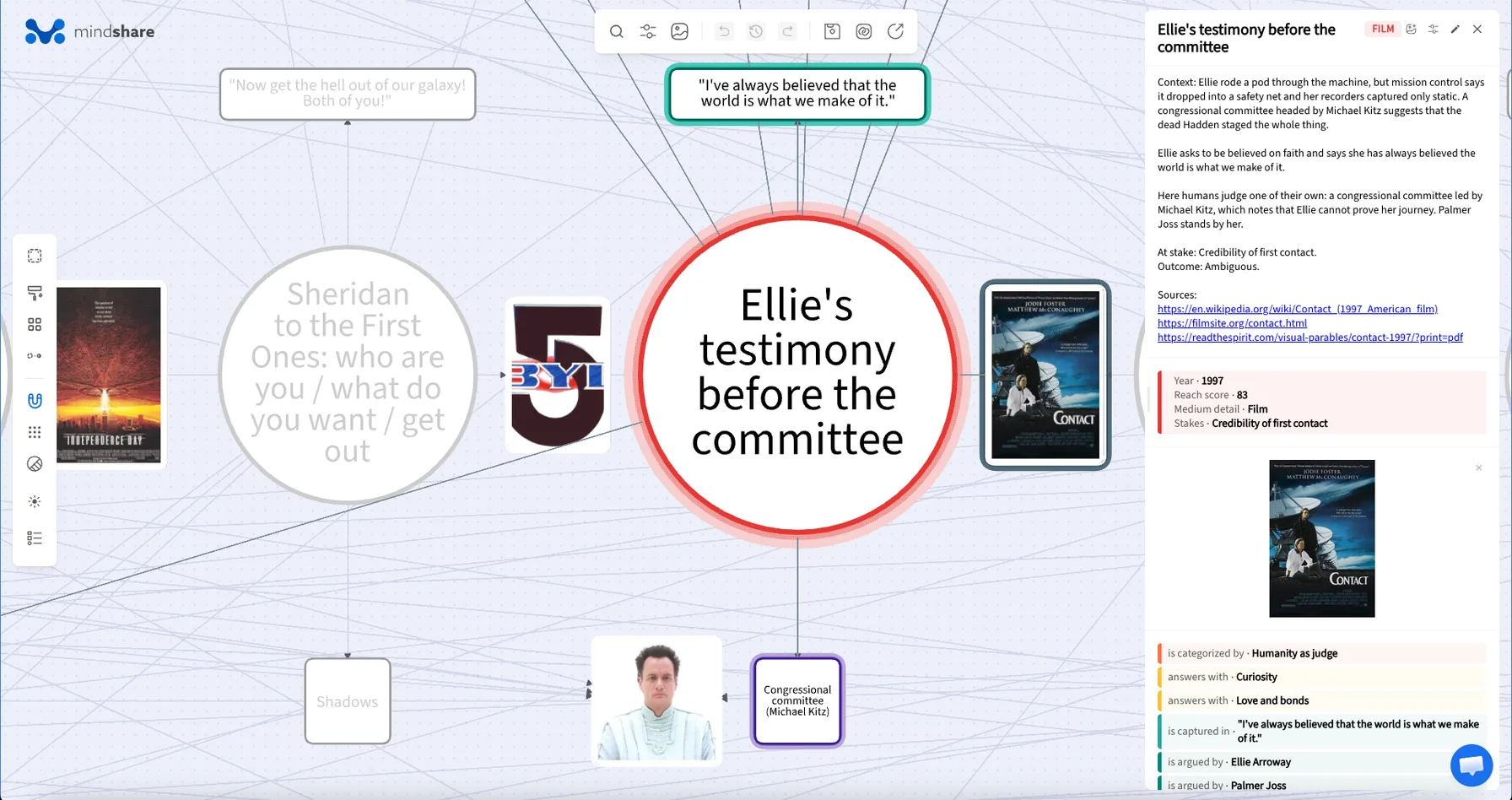
The picture shows the same for Ellie's testimony in Contact (1997): judged by a congressional committee, argued by Ellie Arroway and Palmer Joss with curiosity and love and bonds, in words, and ending with no clear verdict.
-
Follow a judge to others like it
Each judging power leads to its archetype. The heptapods are a shepherd, guiding a young species rather than punishing it. Q is a tester, in company with the Metrons, the Talosians, Balok and the Vorlons, and he links to all four of his trials and to the lines he is remembered for, such as “The trial never ends.”
-
Cross over to the real world
The Voyager Golden Record connects like any story: the stance is humanity introduces itself, the advocate is Carl Sagan, the judge is the unknown listeners, the form is art and message, and the verdict is no verdict. Put it next to a fictional trial and you see the same question asked from both sides.
Map a recurring story of your own
The same approach works for any pattern that repeats across many works: the hero's journey in film, a legal doctrine across court cases, a myth told by different cultures. Decide what the recurring parts are, make each one a type, connect every work to its parts, and add the few numbers or categories you want to compare by. The metadata format shows how to write it down.