Russian Invasion of Ukraine
See how each step of the war led to the next, across every front it was fought on.
News reports a war one day at a time. This knowledge graph lays twelve years of it on one timeline, from the Euromaidan protests to October 2026: intelligence, diplomacy, the front line, weapons, aid, energy, sanctions and the human cost, each in its own row. Arrows run from cause to consequence, so you can follow any decision to what came of it.
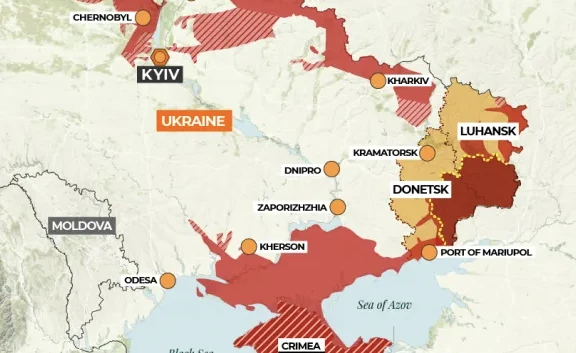
Twelve years on one timeline
Every event, decision, agreement and aid package sits where its date puts it, from left to right, in the row of the field it changed most. A strike on a power station sits in Energy, a strike on a hospital in Humanitarian and justice. The front line runs through the middle, the political and intelligence rows above it, the economic and civilian ones below. The phases of the war run across the top, the people and organisations under them, the places along the bottom.
The busy years take more room than the quiet ones. News articles sit beside the events they report, and quotes beside what they comment on. The bigger the shape, the larger the event's impact.
Four questions this knowledge graph answers
Did anyone see it coming?
Four warnings point at the invasion, all from the United States. In November 2021 US intelligence told allies Russia was planning to invade, a warning made public only later. In December a leaked estimate put the planned force at 175,000 troops. On 11 February 2022 the national security adviser, Jake Sullivan, said an invasion could begin any day, and on 18 February President Biden said Putin had decided.
Follow the arrows in from the other side, and the last steps are Russian decisions: the recognition of the Donetsk and Luhansk people's republics on 21 February, then the upper house's vote to allow the use of force abroad the next day. Two days later the invasion began.
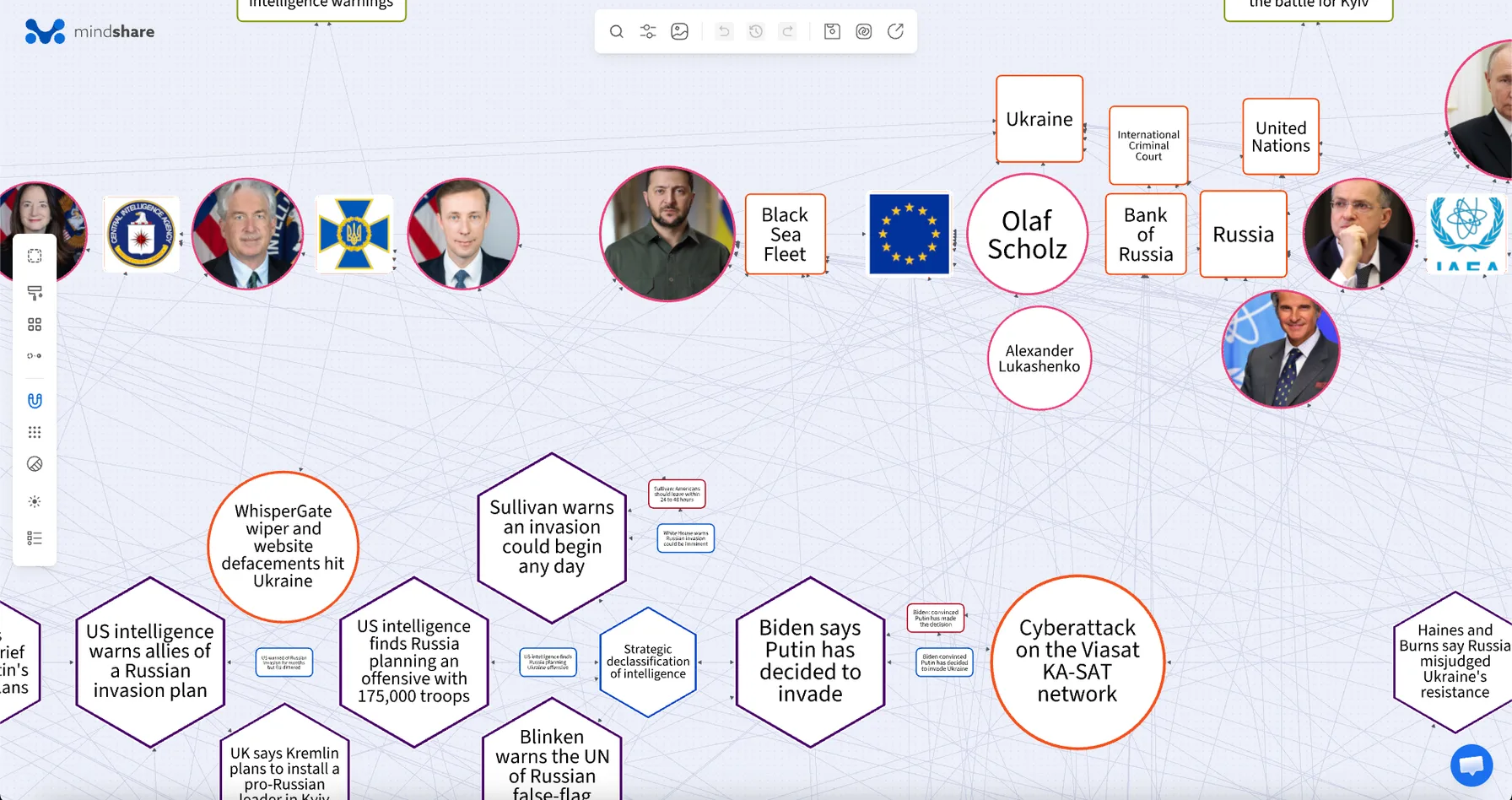
What did the invasion set off?
Within two weeks, the invasion led directly to ten responses that the sources tie to it, in four rows of the timeline at once. Germany decided to send weapons and Russian banks were cut off from SWIFT on 26 February. The next day the EU agreed, for the first time, to pay for weapons for a country under attack, and on 28 February Russia's central bank reserves were frozen. The UN General Assembly condemned the invasion and the International Criminal Court opened an investigation on 2 March; the EU gave refugees from Ukraine temporary protection on 4 March; the US banned Russian oil, gas and coal on 8 March.
Each response has consequences of its own. The reserves freeze led the same day to a key rate of 20 percent in Russia, and later to the long debate over the frozen assets.
Where did the strikes on the grid lead?
From October 2022 to March 2023 Russia struck Ukraine's power grid with missiles and drones. The campaign sits in the Energy row, but its arrows leave it. It prompted Germany to speed up its first IRIS-T air-defence launcher, in the Weapons and drones row. It prompted the December 2022 drone attacks on the Engels and Dyagilevo bomber bases deep inside Russia, which Russia blamed on Ukraine. And in the Humanitarian and justice row, more than a year later, it led to the International Criminal Court's arrest warrants: for two Russian commanders in March 2024, then for Sergei Shoigu and Valery Gerasimov in June.
One campaign, three fields, two years: that is the shape a list of dates hides.
What did a week without US aid change?
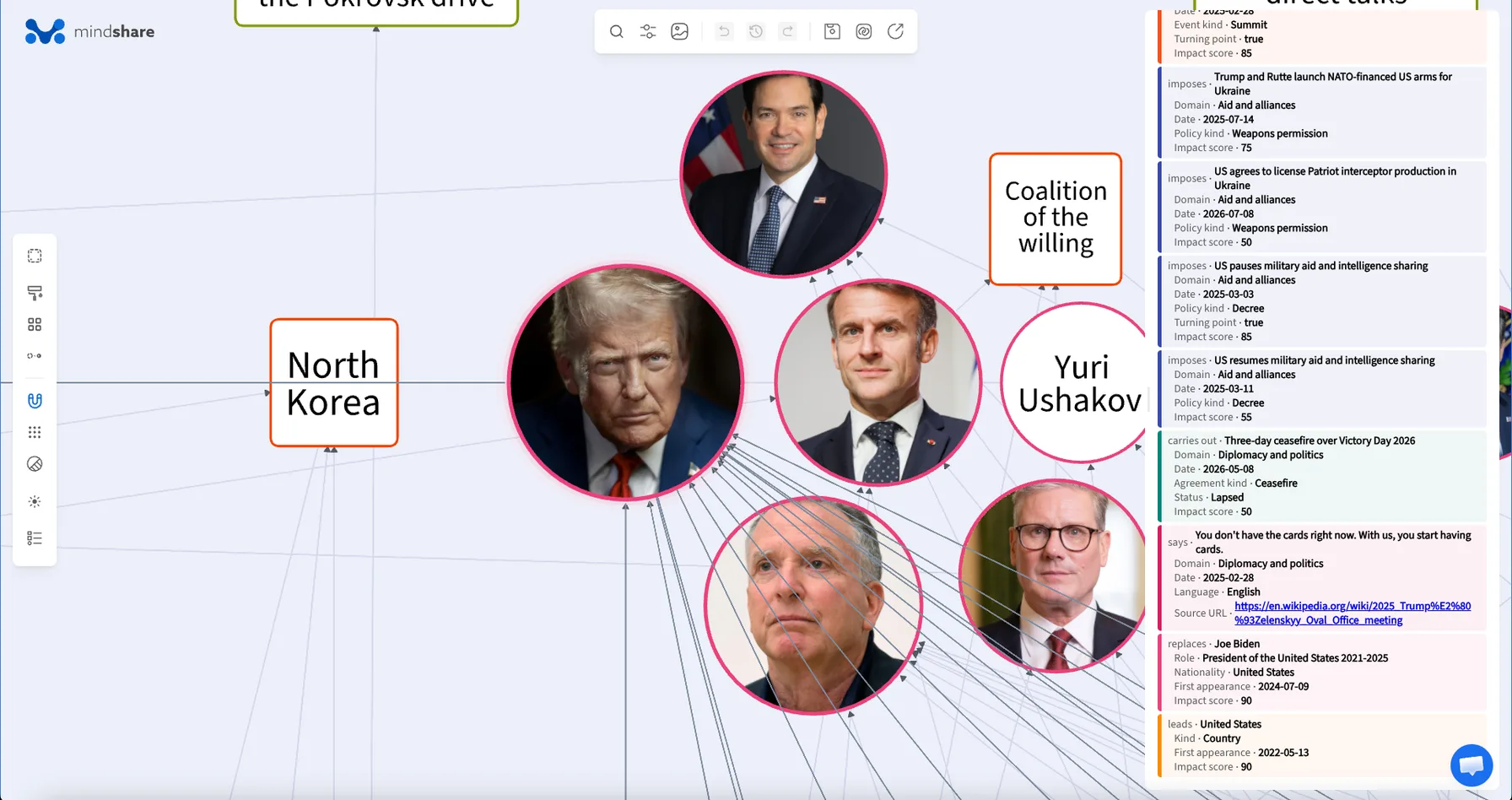
On 28 February 2025 a meeting between Presidents Trump and Zelensky in the Oval Office turned into a public argument. On 3 March the US paused military aid, and then intelligence sharing. The pause ended on 11 March, after talks in Jeddah.
Follow its arrows. On 12 March Ukraine lost control of Sudzha, its main stronghold in Russia's Kursk region, and reports at the time asked what part the pause had played. Further along, the pause shows in a figure for the whole year: European military aid in 2025 of about 29 billion euros, above Europe's average for 2022 to 2024. The Kiel Institute found that total military aid was still lower, because the United States had withdrawn.
How to read the knowledge graph
-
Start at the left edge
Click Russo-Ukrainian War, on the Front line row at the start of the timeline. Its description sums up the war from 2014 to October 2026. Above it, the phases run across the top, from Euromaidan and the annexation of Crimea to Ukrainian counteroffensives and the fight for the fortress belt, which is still open.
-
Open a turning point
Click Freeze of Russia's central bank reserves in the Economy and sanctions row, 28 February 2022. It is marked as a turning point. Its arrows lead to the Russian key rate of 20 percent the same day, to the idea of frozen Russian assets and to the 210 billion euros of them still frozen in the EU in December 2025.
-
Read the coverage
Next to many events sits a news article with its publisher, date, headline and link, and sometimes a quote. Open Zelensky and Trump clash in the Oval Office to find two quotes from the meeting beside it.
-
Follow a weapon
Weapons sit in the Weapons and drones row at the date they were first used in the war. Click Gepard, the German anti-aircraft gun, and follow its arrow to Shahed-136, the drone it counters.
-
Find a place
Places run along the bottom. Click Sudzha, a Russian town in Kursk Oblast. Its connections lead to the Ukrainian incursion that took it in August 2024 and to its loss in March 2025.
Map a history of your own
Any long story with many fields works the same way: a company's history, a policy area, a research topic. Make the kinds of things types, such as event, decision, person and source. Give every dated item a date and the field it belongs to, and connect causes to their consequences, saying how you know. See how properties and types work, or ask us for help preparing the data.